Table of Contents
The first time someone hands you a 60-pound compound bow on the archery range, your brain prepares for a serious physical battle. You hook your release aid to the string, take a deep breath, and begin pulling. For the first few inches, the resistance is immense—your shoulder and back muscles work hard against the stiff composite limbs.
Then, just as you think you cannot pull any further, something extraordinary happens: the string suddenly glides backwards with almost zero effort, dropping into a relaxed pocket right against your cheekbone. Instead of wrestling with 60 pounds of tension, you are now effortlessly holding a featherweight 12 pounds with your index finger.
This dramatic mechanical transformation is known as Let-Off, and it is powered by the egg-shaped rotating wheels mounted at the tips of the bow called Cams. If you are new to archery and wondering how this high-tech machine works without motors or electronics, let's break down the simple physics, the four stages of the draw cycle, and the golden safety rules every beginner must know.
1. The Big Secret: Why Cams Are Not Round Wheels
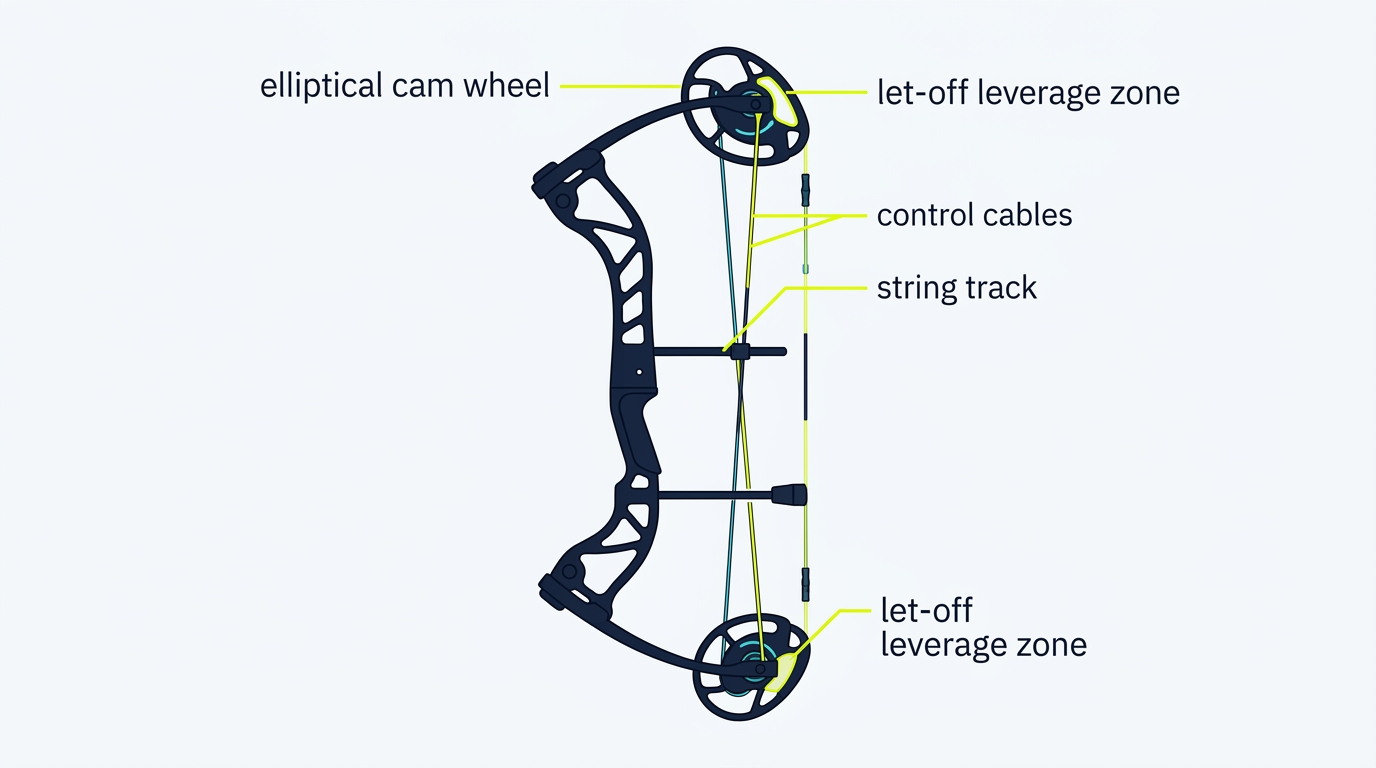
To understand why a compound bow behaves so differently from a traditional wooden recurve or longbow, look closely at the wheels at either end of the limbs. They are not round circles—they are shaped like oblong eggs or pears, mounted with their axle off-center. In mechanical engineering, this is called an eccentric cam.
When you pull a simple circular wheel (like a bucket pulley over a water well), the pulling effort remains 100% constant the entire time. But when an axle is placed off-center on an elliptical cam, the lever arm continuously changes its length as the wheel rotates:
- At the Start of the Draw: The short side of the cam faces the string. You have very little mechanical leverage, meaning your muscles must do the heavy lifting to bend the extremely stiff bow limbs.
- At Full Draw (The Rollover): As the cam rotates past its high point, the long side of the cam flips the leverage in your favor. Suddenly, the mechanical advantage does the work of keeping the limbs bent, relieving your muscles of up to 85% of the holding weight.
This simple trick of physics allows compound bows to store massive amounts of explosive energy in short, rigid limbs while allowing the archer to stand completely calm and relaxed while aiming.
2. The Four Stages of the Compound Draw Cycle
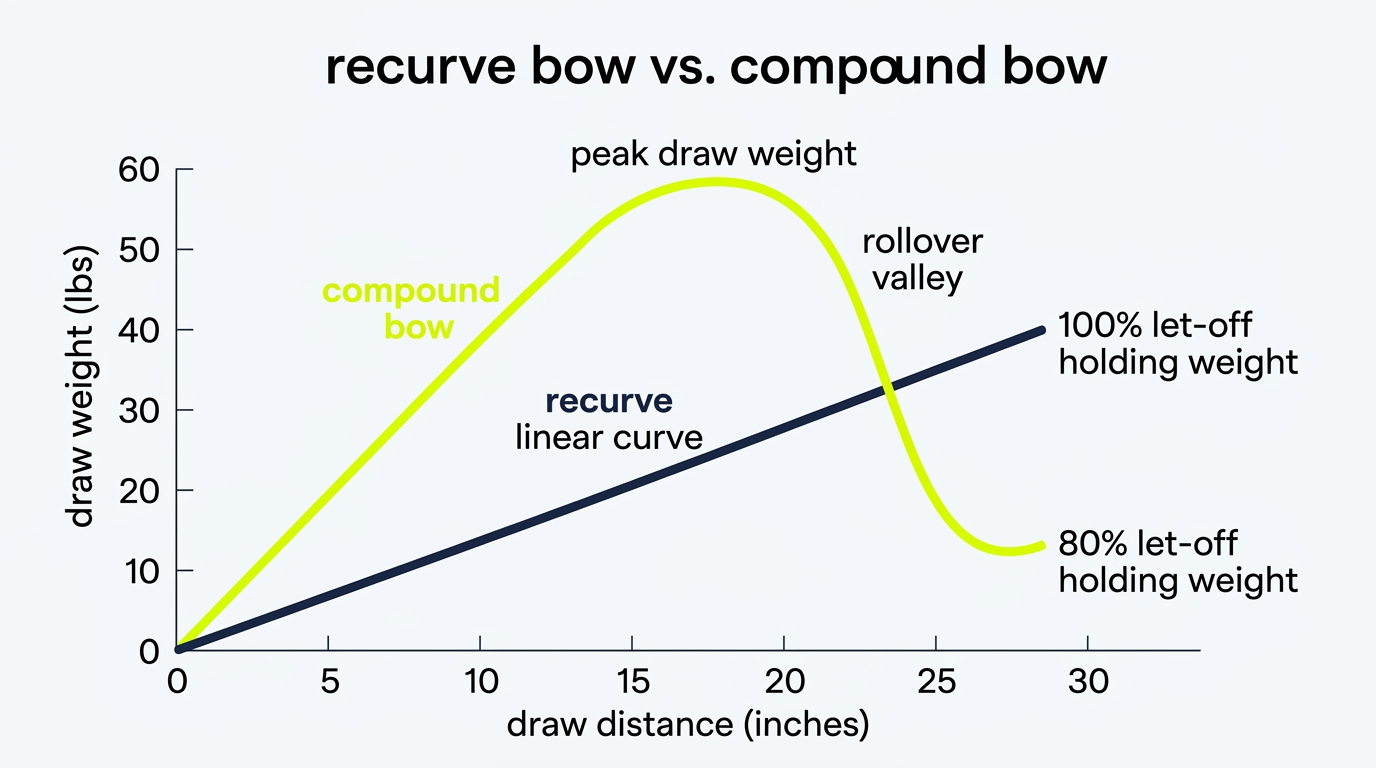
When you draw a recurve bow, the pull feels like stretching a giant rubber band: every centimeter you pull gets progressively heavier. A compound bow does the exact opposite. Understanding the four distinct stages of a compound draw cycle will help you shoot with confidence and avoid startling surprises on the shooting line.
Stage 1: The Power Stroke (Peak Weight)
During the first 6 to 10 inches of the draw, you hit the bow's Peak Weight. If your bow is configured for 50 pounds, you will pull through all 50 pounds immediately. This early power stroke is why compound arrows fly so fast—energy is stored into the limbs at the very start of the movement rather than right at the end.
Stage 2: The Rollover
As you pull past the halfway point, the eccentric lobes of the cams roll over their highest radius. You will feel a distinct transition point where the heavy resistance suddenly starts dropping away. Beginners often describe this sensation like rolling a heavy boulder over the crest of a hill—once you reach the peak, gravity takes over.
Stage 3: The Valley and Let-Off
After the rollover, the string drops smoothly into what archers call The Valley. This is the resting zone where let-off takes full effect:
- 70% Let-Off: On a 50 lb bow, you hold only 15 lbs at your face.
- 80% Let-Off: On a 60 lb bow, you hold only 12 lbs at your face.
- 85% Let-Off: On a 70 lb hunting bow, you hold just 10.5 lbs at your face.
Because you are holding barely a fraction of the total poundage, your chest and shoulder muscles stay relaxed. Your heart rate remains steady, and you can hold your sight pin perfectly centered on the target without muscle tremors.
Stage 4: The Solid Back Wall
At the very end of the valley, the string stops moving completely. You cannot pull it back even one millimeter further. This firm boundary is called the Back Wall. It guarantees that every single shot is drawn to the exact same millimeter of draw length, delivering identical arrow speed and pinpoint vertical consistency.
3. Cable Stops vs. Limb Stops: How the Back Wall Works
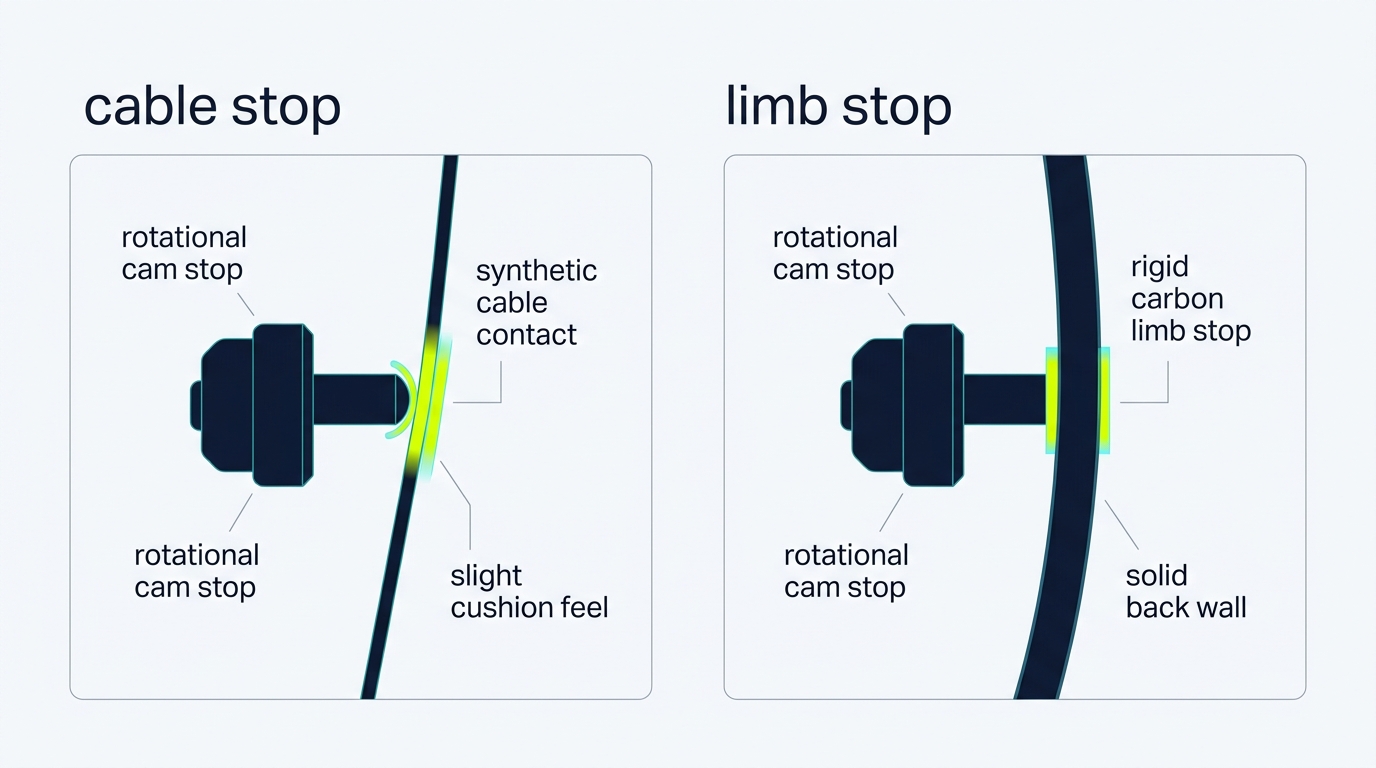
How does a compound bow create that immovable back wall? Inside the cam assembly, manufacturers install small mechanical pegs called Draw Stops. There are two primary types used in modern compound bows:
Cable Stops (The Firm Cushion)
With a cable stop setup, the rotating cam peg bumps directly against the synthetic harness cables at full draw. Because synthetic fiber cables have a microscopic amount of elastic flex, cable stops provide a very firm wall with a tiny touch of "give." Many target archers love cable stops because it allows them to execute their shot using continuous back tension without pulling the bow out of alignment.
Limb Stops (The Rock-Solid Concrete Wall)
With a limb stop setup, the cam peg rotates until it physically impacts the rigid carbon fiber surface of the bow limb. Because the limb cannot compress, the back wall feels like hitting a slab of solid concrete. If you pull harder, the string will not budge a fraction of a millimeter. Beginners often find limb stops comforting because there is zero ambiguity about whether you have reached full draw.
4. The Four Cam Types Explained in Plain English
When browsing compound bows, you will encounter terms like Single Cam, Dual Cam, Binary Cam, and Hybrid Cam. Here is what those configurations actually mean for you as a beginner:
| Cam Configuration | How It Is Built | Why Beginners Like It | Things to Keep in Mind |
|---|---|---|---|
| Single Cam (Solocam) | One round idler wheel on top, one power cam on the bottom. | Zero timing issues. Because there is only one cam, you never have to synchronize two wheels. | Slightly lower arrow velocity compared to dual-cam setups. |
| Dual Cam | Two identical, independent power cams on top and bottom. | Blazing fast arrow speeds and perfectly level arrow launch. | Requires regular tuning so both cams hit their stops at the exact same millisecond. |
| Binary Cam | Two synchronized cams slaved directly to one another via control cables. | Self-correcting timing. Delivers tournament-grade precision with minimal maintenance. | Standard design on most modern high-performance target bows. |
| Hybrid Cam | One control cam on top, one power cam on the bottom. | Smooth draw cycle with excellent speed and very low maintenance needs. | Popular across all-around beginner and intermediate compound packages. |
5. Three Vital Safety Rules Every Beginner Must Know
Because compound bows store tremendous mechanical energy inside ultra-stiff limbs, there are three critical safety rules that every archer must respect from day one:
1. Never "Dry-Fire" a Compound Bow
Dry-firing means pulling the bowstring back and releasing it without an arrow loaded. In normal shooting, the heavy carbon arrow absorbs over 85% of the limb's stored energy. If you release the string without an arrow, that massive shockwave has nowhere to go—it violently shatters the fiberglass limbs, derails the cables, and bends the aluminum cams, potentially causing severe facial injury. Never dry-fire any bow under any circumstances.
2. Always Use a Mechanical Release Aid (Never Bare Fingers)
Unlike recurve bows which are designed for leather finger tabs, modern compound bows have very short axle-to-axle lengths. Pulling a compound string with your bare fingers pinches the string at a steep angle, introducing horizontal torque. This torque can cause the string to derail off the narrow cam tracks during the draw cycle. Always use a proper caliper wrist-strap or handheld thumb release aid.
3. Do Not Let Down Abruptly Past the Valley
If you need to let down your draw without shooting (for example, if a gust of wind blows or someone walks across the field), remember that the let-off will reverse as soon as you push forward past the rollover peak! Prepare your shoulder muscles to catch that 50 or 60 pounds of resistance as the cams roll forward, and guide the string back to rest slowly and smoothly.
Summary: Mechanical Precision That Empowers Your Shot
The eccentric cam and let-off system is one of the greatest innovations in the history of sports engineering. By shifting the physical workload from your holding muscles to high-efficiency mechanical levers, compound bows allow archers of all ages and fitness levels to focus on the purest elements of archery: sight picture alignment, breath control, and a crisp, surprise release.
To see how compound bows compare directly to Olympic recurve and traditional barebow setups, be sure to read our complete guide on Recurve, Compound, or Barebow: What's the Real Difference?.

Dedicated to delivering clear, authoritative, and practical archery education and tournament insight.