Table of Contents
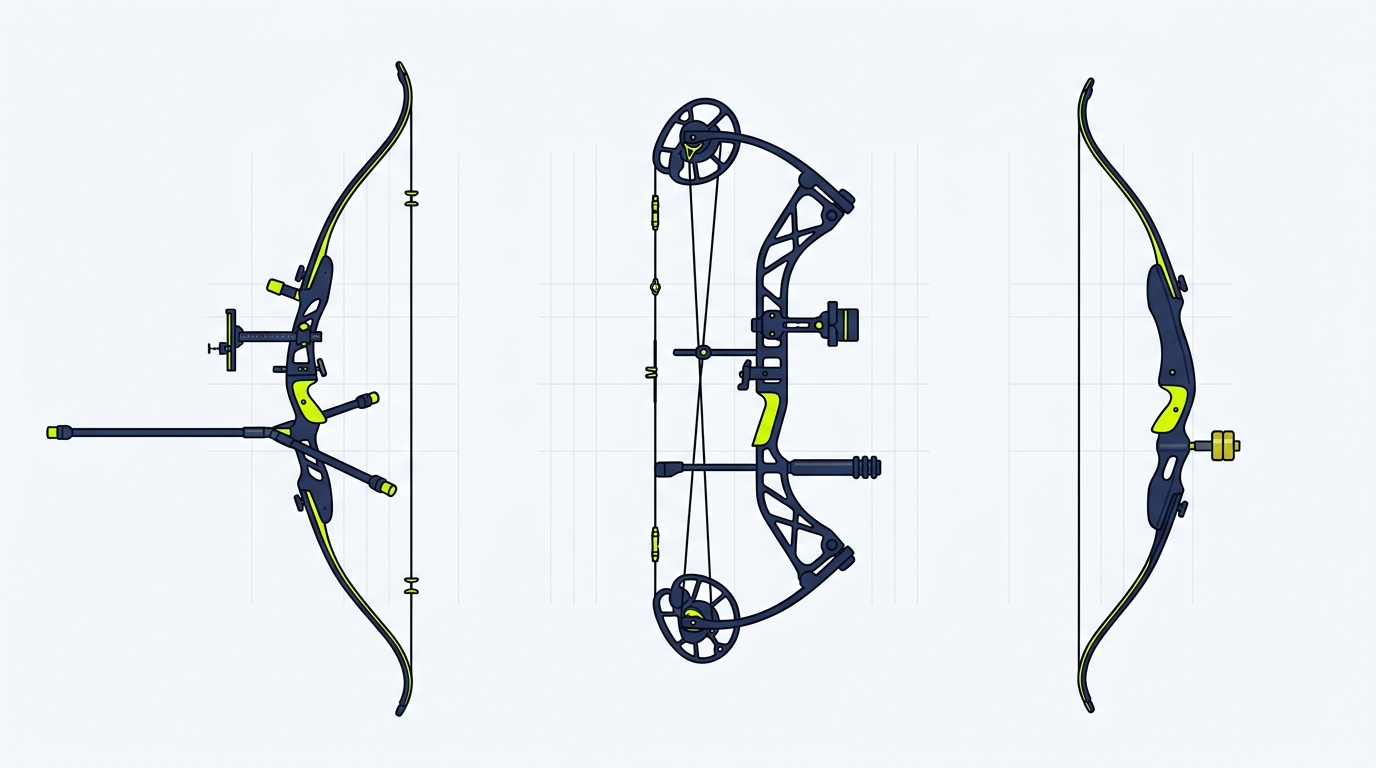
Walk along the shooting line at any archery club on a Saturday morning, and the first thing you notice is how wildly different everyone's setup looks. To your left, an archer stands tall, drawing a sleek, graceful bow equipped with long carbon balance rods and a single bright sight pin. Right beside them, another archer draws a compact, high-tech machine of cables and rotating wheels, using a handheld mechanical trigger. Further down the lane, a third archer shoots a traditional-looking bow with zero sights, rods, or gadgets at all—placing their fingers carefully along the bowstring and sinking arrow after arrow dead-center into the yellow ten-ring.
While every archer shares the exact same goal—putting arrows cleanly into the target face—the modern sport divides into three major disciplines recognized worldwide by World Archery: the Olympic Recurve, the Modern Compound, and the Traditional Barebow.
Each style offers a completely different rhythm, physical sensation, and mental challenge. If you are choosing your very first bow or wondering why your range mates shoot what they shoot, let's break down how these three iconic bow types work, how they feel in your hands, and how to pick the right one for you.
1. Olympic Recurve: Flowing Athleticism and Classical Form
The recurve bow is the classical archetype of target archery and the only bow discipline featured in the Olympic Games. Its name comes from the distinct forward-swept curve at the tip of each limb. When you string the bow, the bowstring rests directly against the inner face of these curves, storing greater potential energy and transferring it to the arrow with higher velocity than a straight-limbed longbow.
The Spring Effect and Full Holding Weight
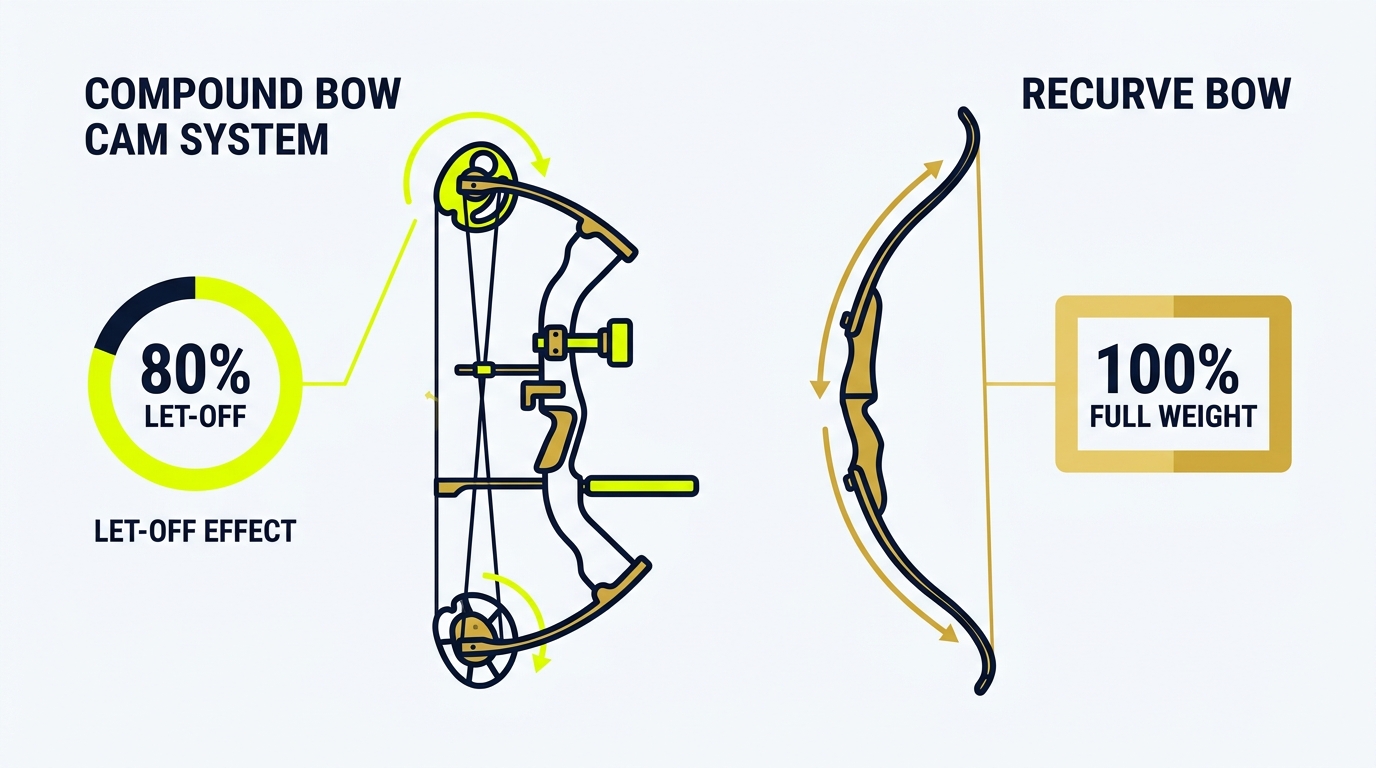
Think of drawing a recurve bow like stretching a giant spring: the further back you pull the string toward your jawline, the heavier it fights back against you. When your limbs are rated at 30 pounds, by the time you reach your anchor point under your chin, your upper-back muscles (the rhomboids between your shoulder blades) are holding every single ounce of that 30 pounds.
There are no gears, pulleys, or mechanical stops to relieve the tension. That means your skeletal alignment, core stability, and steady breathing must do all the work. If your posture collapses even half a millimeter, the arrow will fly off target. It is why recurve archery feels like an organic martial art—pure harmony between your body and the bow.
The Olympic Accessory Suite
To help archers replicate this exact shot cycle 72 times in a tournament round, an Olympic recurve uses specialized accessories:
- Single-Pin Sight: An adjustable sighting mechanism mounted to the riser that allows fine elevation and windage calibration for distances up to 70 meters.
- Mechanical Clicker: A thin spring-steel blade mounted over the arrow shaft. As you expand through your final millimeter of draw, the arrow point slides under the blade with an audible click—your brain's cue to release instantly.
- Stabilizer Rods: Extended carbon rods acting like a tightrope walker's balance pole. They increase the bow's rotational stability, eliminate hand torque, and absorb shot vibration.
- Leather Finger Tab: A smooth cordovan leather tab with an aluminum shelf that presses firmly under your jawline for an exact anchor reference on every shot.
2. Modern Compound: Mechanical Advantage and Rifle-Like Precision
Developed in the late 1960s, the compound bow is an engineering triumph designed to maximize arrow speed and mechanical efficiency through a system of synchronized cables and rotating elliptical wheels called cams.
The Let-Off Surprise: Why 60 Pounds Feels Like 12
If you hand a compound bow to someone who has only ever shot a recurve, their reaction is always complete astonishment. When you begin drawing a 60-pound compound, you feel all 60 pounds immediately during the first few inches of movement. But as the elliptical cams roll over at full draw, the mechanical leverage flips.
Most modern target compound bows deliver 70% to 85% Let-Off. That means on a 60-pound bow, once you hit the solid back wall of the draw cycle, you are only holding a featherweight 9 to 15 pounds at your face! This drastic drop in holding weight eliminates muscle tremor, allowing you to settle your sight pin dead-center and execute your shot with absolute composure.
Optics, Triggers, and High-Speed Ballistics
Compound archery replaces human finger release with mechanical consistency:
- Handheld Release Aids: A mechanical trigger (thumb button, wrist strap, or back-tension hinge) clips directly onto a D-loop tied to the bowstring. Squeezing the trigger opens the jaws cleanly, removing finger friction entirely.
- Peep Sight & Magnified Scope: A small circular window in the bowstring aligns with a magnified glass lens (2x to 8x) on the sight bar, creating a rifle-like crosshair view.
- High Arrow Velocity: With stiff composite split-limbs and high-energy cam tracks, compound arrows fly between 280 and 340 feet per second (fps). The trajectory is so flat that wind drift is dramatically reduced at 50 meters.
3. Traditional Barebow: Raw Mechanics and the Finger-Slider Secret
Barebow takes the high-performance modern recurve riser and carbon limbs, but strips away every external aiming device, electronic accessory, and stabilization rod. Under World Archery rules, a barebow cannot have a sight, a clicker, or any protruding stabilizer bar.
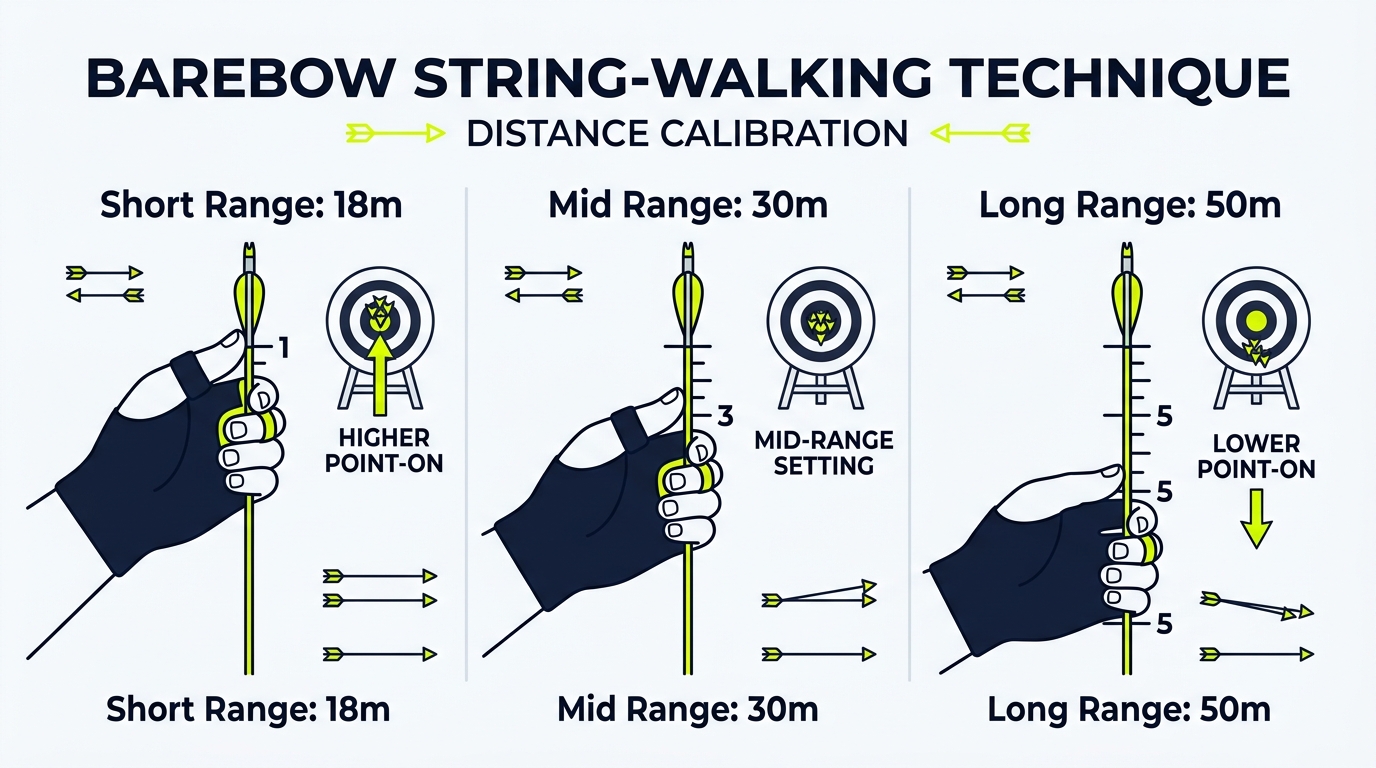
How Barebow Archers Aim Without Sights: String-Walking
How can an archer consistently hit a 10-ring at 50 meters without a sight pin or scope lens? It is not guesswork—it is pure geometry.
Barebow archers use a technique called String-Walking. Their leather finger tab features uniform laser-etched stitch marks. By sliding their fingers down the string beneath the arrow nock, they adjust where the arrow sits relative to their eye:
- Short Distances (e.g., 18 meters): Crawling several stitches down the string brings the back of the arrow up closer to the eye, lowering the flight angle so the arrow tip points directly at the bullseye.
- Long Distances (e.g., 50 meters): Gripping the string right under the nock elevates the arrow trajectory for maximum distance.
Lower Riser Weights and the 12.2 cm Ring Rule
Under World Archery regulations, barebow archers cannot attach long stabilizer rods. To prevent the top limb from violently kicking backward into the archer's face upon release, they screw dense brass or stainless steel weights directly into the lower bushings of the riser.
The entire unbraced bow, weights included, must pass cleanly through an official 12.2-centimeter inspection ring before tournament competition.
4. Direct Comparison: Key Specifications at a Glance
The table below provides a direct technical comparison across all three major target archery disciplines:
| Key Metric / Attribute | Olympic Recurve | Modern Compound | Traditional Barebow |
|---|---|---|---|
| Olympic Recognition | Official Olympic Discipline | World Games & World Cups | World Games & 3D / Field |
| Holding Weight at Anchor | 100% of Draw Weight | 15% to 30% (70–85% Let-off) | 100% of Draw Weight |
| Release Method | Finger Tab (3 Fingers) | Mechanical Release Aid | Finger Tab (String-Walking) |
| Sight System | Single Pin Sight (No Lens) | Magnified Scope + Peep Sight | None (Arrow Tip Reference) |
| Stabilization Setup | Full Multi-Rod Carbon System | Front & Side V-Bar System | Internal Lower Riser Weights |
| Standard Target Distance | 70 Meters (122 cm Target Face) | 50 Meters (80 cm Target Face) | 50 Meters (122 cm Target Face) |
| Average Arrow Velocity | 180 – 220 fps | 280 – 340 fps | 160 – 200 fps |
| Primary Training Focus | Back tension, rhythm & expansion | Equipment tuning & calm release | String crawl calibration & anchor |
5. Which Bow Type Matches Your Personality?
Choosing your primary bow type should reflect your personal motivations, physical goals, and how you enjoy practicing sport.
Choose Olympic Recurve If:
You appreciate classical sports discipline, biomechanical mastery, and the satisfaction of building smooth shot timing. Recurve archery rewards patient athletes who enjoy developing consistent body structure, steady breathing, and graceful execution under pressure. It is also the ideal choice if you dream of pursuing the Olympic pathway.
Choose Modern Compound If:
You love precision engineering, mechanical tuning, and tight arrow groupings. Compound archery is characterized by extreme accuracy where even a millimeter deviation separates gold from silver. If you enjoy working with high-tech gear, optical sights, and fast arrow flight, compound will provide immediate engagement.
Choose Traditional Barebow If:
You want an authentic, uncluttered connection with your bow. Barebow archers enjoy the mental challenge of calculating their sight picture through string-walking and mastering form fundamentals without relying on stabilizer rods or optical lenses. Barebow is also popular in 3D and field archery where shooting takes place in natural forest terrain at unmarked distances.
6. Three Candid Tips for Buying Your First Bow
Before purchasing your initial archery equipment, keep these practical coach guidelines in mind to avoid common beginner pitfalls:
1. Beware the "Ego-Lifting" Poundage Trap
The most common beginner mistake is purchasing heavy limbs (30+ lbs for recurve or 60+ lbs for compound) too soon. Over-bowing leads to shoulder fatigue, poor posture, and target panic. Begin with light rental limbs (20 to 24 lbs) so your back muscles and tendon structures adapt comfortably to the movement pattern.
2. Invest in an ILF-Compatible Recurve Riser
If you choose recurve or barebow, purchase an ILF (International Limb Fitting) riser. The ILF standard allows you to swap limb sets freely across various manufacturers without buying a new handle, making poundage upgrades affordable as your strength grows.
3. Measure Your Draw Length Before Ordering Arrows
Your correct draw length determines arrow shaft length, spine stiffness, and bow sizing. Visit a certified local archery club or pro shop to measure your draw length and dominant eye before ordering gear online.
Summary: Finding Your Path on the Shooting Line
Every archery discipline offers a rewarding path to focus, physical discipline, and mental clarity. There is no single superior bow—the best bow is simply the one that inspires you to step up to the shooting line and enjoy every shot. Try out different bow styles at your local archery club, feel how each one responds in your hands, and embark on your archery journey with confidence.

Dedicated to delivering clear, authoritative, and practical archery education and tournament insight.