Table of Contents
Every four years, millions of sports fans around the world tune in to the Olympic Games and find themselves completely glued to the archery broadcast. Two archers stand on an open, sunlit field. Heart rate monitors pulse rapidly on the television screen. The wind gently rustles their shirt sleeves as a countdown clock ticks down from 20 seconds. An archer releases—and 70 meters away, an arrow slams dead-center into a bright yellow circle.
To the untrained eye, Olympic archery looks almost impossible. How can a human being hit a target smaller than a grapefruit from across an entire football pitch without optical magnification? And how do the brackets, sets, and shoot-offs actually work?
Whether you are an aspiring archer dreaming of the international stage or an enthusiastic spectator wanting to understand every referee signal, here is your beginner-friendly guide to how Olympic archery works.
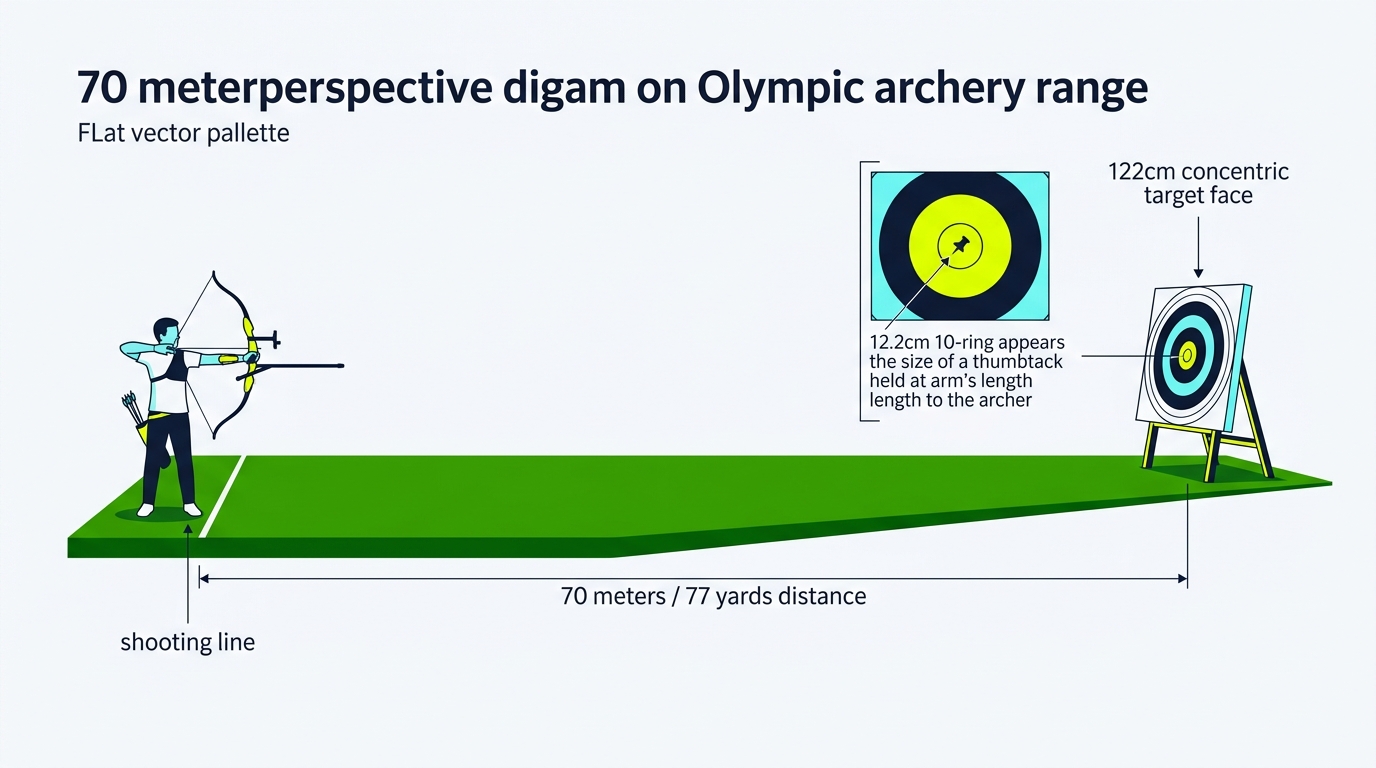
Understanding the 70m Shooting Distance: The visual diagram above demonstrates the true scale of an Olympic archery range. The target face is placed at a standard height of 130 cm from the ground to the center, positioned 70 meters away from the shooting line. Across this 77-yard expanse, the entire 122 cm target appears compact, while the coveted 12.2 cm 10-ring gold center is a tiny speck that requires absolute precision, flawless form, and steady wind compensation to hit consistently.
1. The 70-Meter Challenge: Putting the Distance in Perspective
The defining hallmark of Olympic archery is its standardized competition distance: 70 meters (77 yards).
To truly appreciate what Olympic archers accomplish, imagine standing at one end of an official FIFA soccer field and aiming at a circular target placed near the opposing penalty box:
- The Target Face: Measures 122 centimeters (48 inches) in diameter—about the size of a large round coffee table.
- The 10-Ring (Bullseye): Measures just 12.2 centimeters (4.8 inches) wide—roughly the diameter of a standard music compact disc (CD) or a grapefruit.
- The Archer's View: When looking down the shooting line from 70 meters away, that 12.2 cm yellow 10-ring appears roughly the size of a thumbtack head held at arm's length!
At 70 meters, an average Olympic arrow flies at approximately 200 feet per second (136 mph), taking roughly 1.1 seconds to travel from the bowstring into the foam target butt.
2. The Only Olympic Bow: The Recurve Discipline Exclusive
Why do you never see compound bows with rotating wheels or magnifying scopes at the Olympic Games? Under World Archery and International Olympic Committee (IOC) charter, Olympic archery is exclusively contested using the Recurve bow.
The Olympics celebrates pure human athletic mastery. While compound bows utilize mechanical cams that reduce holding weight and use magnifying glass scopes, an Olympic recurve requires the athlete to:
- Hold 100% of the bow's draw weight (typically 40 to 50 lbs) using only their back muscles.
- Release the bowstring with three bare fingers protected by a simple leather tab (no mechanical trigger releases allowed).
- Aim using a single, non-magnified pin sight without optical lenses or electronics.
The Olympic program features five distinct medal events: Men's Individual, Women's Individual, Men's Team (3 archers), Women's Team (3 archers), and the fast-paced Mixed Team event (1 man + 1 woman).
3. The Two-Stage Competition: From Ranking to Knockout Finals
An Olympic archery tournament is structured into two distinct phases: the Qualification Ranking Round and the Olympic Elimination Brackets.
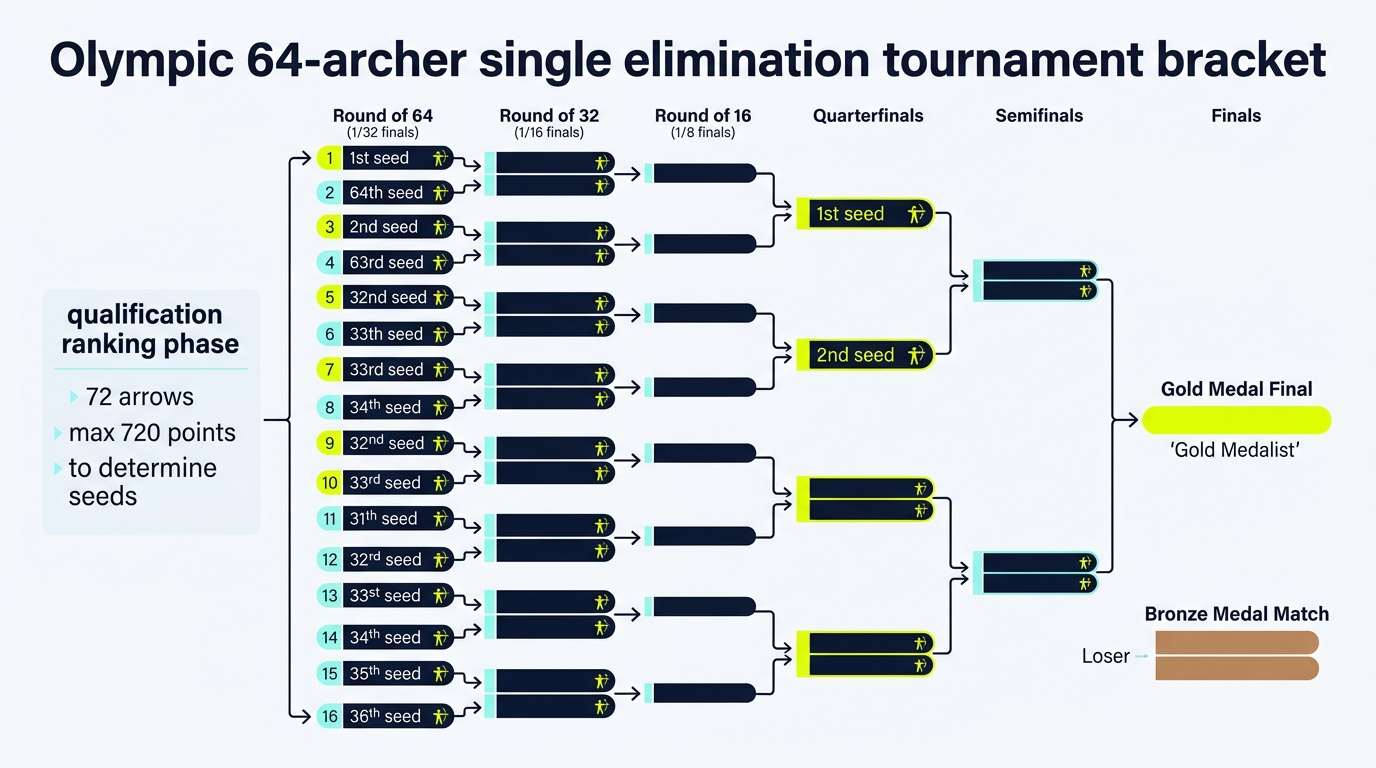
Understanding the Olympic Tournament Bracket: As shown in Diagram 2 above, the single-elimination tournament structure pairs top-seeded qualifiers directly against lower seeds in the opening 1/32 round (#1 vs #64, #2 vs #63). Each head-to-head match is contested under set system scoring. Archers who triumph through five consecutive rounds reach the Gold and Bronze medal matches, where every single arrow under the 20-second alternating shot clock directly determines Olympic podium glory.
Stage 1: The 72-Arrow Qualification Round (Seeding)
On Day 1 of the Games, all 64 men and 64 women step up to the shooting line simultaneously. Each archer shoots 72 arrows in 12 ends of 6 arrows at 70 meters, for a maximum possible score of 720 points.
Crucial Rule for Beginners: Nobody gets eliminated during the qualification round! The sole purpose of these 72 arrows is to rank every athlete from 1st seed down to 64th seed.
Stage 2: Head-to-Head Elimination Brackets (Knockouts)
Once seeding is complete, archers enter a single-elimination tournament bracket where the highest-ranked athletes are rewarded with matchups against lower seeds:
- The #1 Seed faces the #64 Seed.
- The #2 Seed faces the #63 Seed.
- Winners advance to the 1/16 round, 1/8 round, Quarterfinals, Semifinals, and the televised Gold and Bronze medal matches. One loss, and your Olympic tournament is over!
4. The Set System and the 20-Second Shot Clock
In individual match play, archers do not add up total points over the entire day. Instead, they battle in head-to-head Sets of 3 arrows using the World Archery Set System:
- Both archers shoot 3 arrows per set (max 30 points).
- The winner of the set receives 2 Set Points; a tie awards 1 Set Point to each archer.
- The first athlete to accumulate 6 Set Points wins the match!
The 20-Second Alternating Shot Clock
During televised medal finals, archers do not shoot at the same time. They shoot in alternating turns from a raised finals podium:
- The higher-seeded archer decides who shoots first in Set 1.
- When an archer steps to the line, a digital clock immediately counts down from 20 seconds.
- The athlete must raise the bow, anchor, aim, and release cleanly before the timer hits zero. As soon as the arrow hits the target, the clock switches to the opponent, who now has 20 seconds to respond!
5. Olympic Archery Specifications at a Glance
Here is a quick summary of the official competition parameters across the three major Olympic formats:
| Event Category | Distance & Target Face | Match Format | Time Limit per Arrow |
|---|---|---|---|
| Individual (Men & Women) | 70 Meters / 122 cm Face | Sets of 3 arrows (First to 6 Set Points) | 20 seconds per arrow (Alternating) |
| Team Event (3 Archers) | 70 Meters / 122 cm Face | Sets of 6 arrows (2 per archer; First to 5 Set Points) | 120 seconds total for all 6 arrows |
| Mixed Team (1 Man + 1 Woman) | 70 Meters / 122 cm Face | Sets of 4 arrows (2 per archer; First to 5 Set Points) | 80 seconds total for all 4 arrows |
| Individual Shoot-Off | 70 Meters / 122 cm Face | 1 single arrow (Closest to center X wins) | 20 seconds per arrow |
6. High-Stakes Olympic Drama: What to Watch For
1. The 10-Ring One-Arrow Shoot-Off
If an Olympic match reaches a 5–5 tie, both archers step up for a sudden-death single arrow. If both shoot a 10, officials walk downfield with a precision digital caliper to measure which arrow is closer to the microscopic center cross. A gold medal can be decided by as little as 0.3 millimeters!
2. Wind Flags and Atmosphere Management
Notice the small wind ribbons placed along the 70-meter field. Because a 10 mph crosswind can blow an arrow over 30 centimeters off course, elite Olympic archers deliberately aim at the blue or red rings into the wind, letting the breeze drift the arrow back into the yellow 10-ring.
Summary: The Pinnacle of Athletic Focus
Olympic archery combines raw physical strength with ice-cold mental discipline. It is a sport where victory requires repeating an exact millimeter movement under the gaze of millions of spectators.
Want to know what it is like to step up to the shooting line at your very first real-world tournament? Read our next guide on How Archery Tournaments Work: What to Expect in Your First Competition.

Dedicated to delivering clear, authoritative, and practical archery education and tournament insight.