Table of Contents
A newcomer walks into an archery club for the first time, looks at a rack of recurve bows, and immediately gravitates toward the heaviest one available. We hear it all the time on the shooting line: "I lift weights at the gym five days a week, so I should easily handle a 40 or 50-pound bow!"
Ten minutes later, that same person is trembling at full draw, their shoulder is creeping up toward their ear, their breathing is ragged, and their arrows are scattering all over the grass. Why does this happen?
Because archery does not rely on your bench-press chest muscles or bicep mirror muscles. It is powered by deep, delicate postural muscles around your upper back (the *rhomboids*) and shoulder rotator cuffs. Pulling a bow that is too heavy—a mistake known as Over-Bowing—is the single fastest path to bad form, target panic, and painful rotator cuff tendonitis.
To shoot with grace, consistency, and laser-tight arrow groups, your bow must be tailored to your body in two vital dimensions: your Draw Weight and your Draw Length. Here is how to find your perfect fit from day one.
1. What Is Draw Length (and How to Measure It at Home)
Your Draw Length is the distance from the pivot point of the bow grip to the nocking point on the string when you are standing at your full, comfortable shooting posture with your anchor hand tucked firmly under your jawline.
Because everyone has different arm lengths and shoulder widths, shooting a bow with the wrong draw length forces you to either hunch your back or over-extend your shoulder, making consistent aiming virtually impossible.
The Golden Wingspan Formula (DIY Home Measurement)
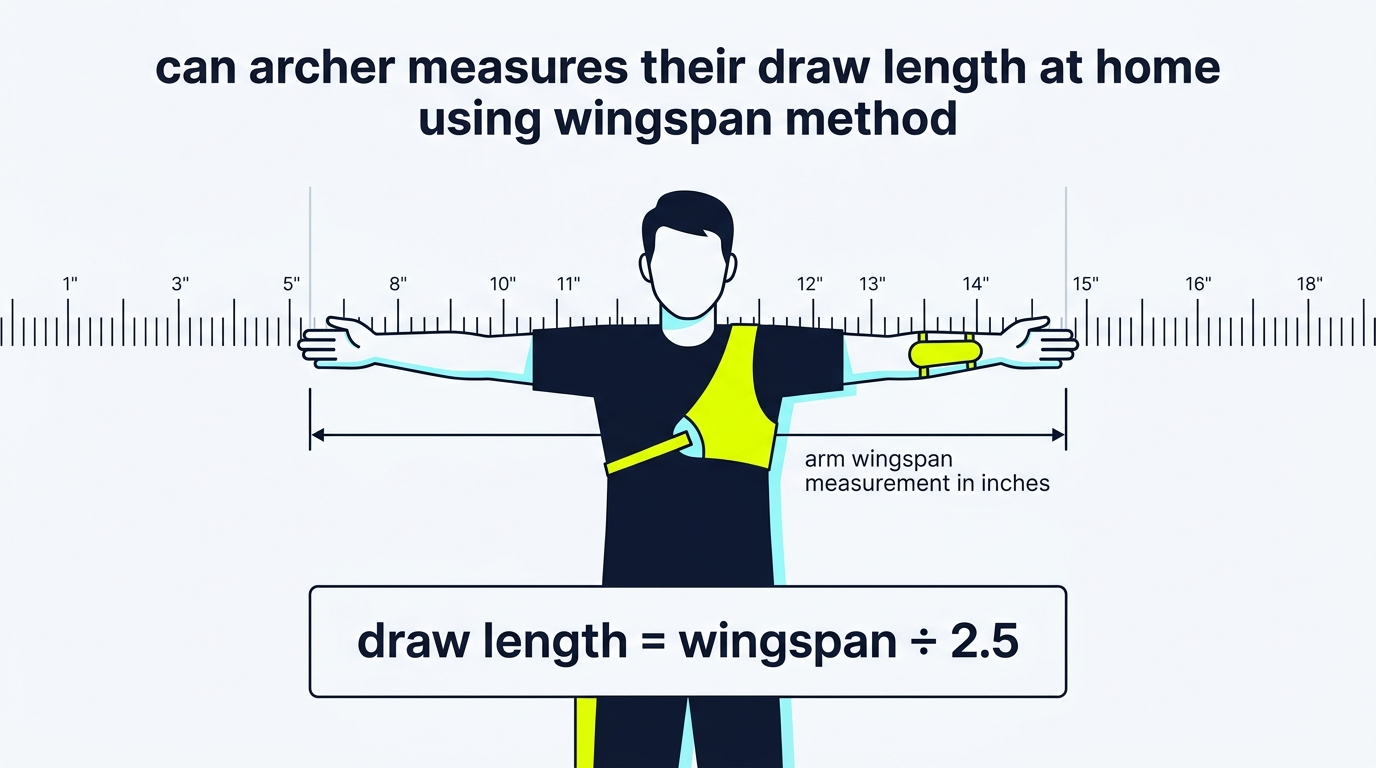
You do not need a professional archery shop to get an accurate estimate of your draw length. You can calculate it in two minutes at home using the standard Wingspan $div$ 2.5 Method:
- Stand Naturally Against a Flat Wall: Spread your arms straight out to the sides at shoulder height, forming a "T" shape with your palms facing forward. Do not strain or stretch unnaturally—maintain relaxed, normal posture.
- Measure Fingertip to Fingertip: Have a friend measure the total distance in inches from the tip of your left middle finger to the tip of your right middle finger. (If measuring in centimeters, convert to inches by dividing by 2.54).
- Divide by 2.5: Take your total wingspan in inches and divide it by 2.5. The resulting number is your baseline draw length.
Example: If your arm wingspan measures 70 inches, your calculation is: $$ ext{Draw Length} = 70 div 2.5 = 28 ext{ inches}$$
2. How Draw Length Dictates Your Recurve Bow Size
Once you know your draw length, you can choose the correct physical length for your recurve bow (measured from tip to tip along the limbs). Shooting a bow that is too short for your draw length causes the limbs to "stack"—a harsh mechanical wall where the string angle pinches your fingers and resistance spikes sharply.
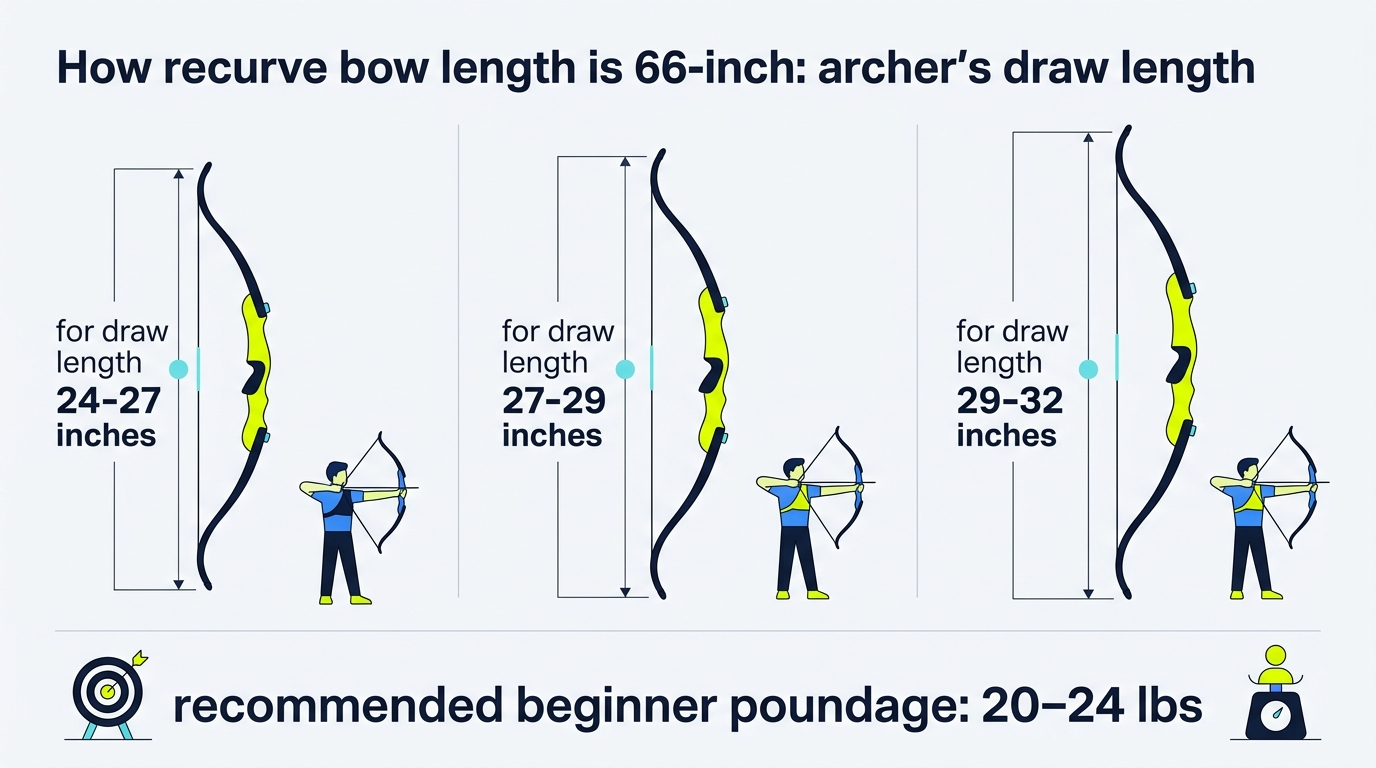
Use this reference table to match your draw length to the standard Olympic recurve bow sizes:
| Archer Wingspan | Calculated Draw Length | Recommended Recurve Bow Size | Riser & Limb Setup |
|---|---|---|---|
| Under 62 inches | Under 24.5 inches | 62 – 64 Inches | 21" or 23" Riser + Short Limbs |
| 63 – 67 inches | 25.0 – 26.5 inches | 66 Inches | 25" Riser + Short Limbs |
| 68 – 72 inches | 27.0 – 28.5 inches | 68 Inches | 25" Riser + Medium Limbs |
| 73 – 77 inches | 29.0 – 30.5 inches | 70 Inches | 25" Riser + Long Limbs |
| 78+ inches | 31.0+ inches | 72 Inches | 27" Riser + Long Limbs |
3. Demystifying Draw Weight: The 28-Inch AMO Rule
When you see a pair of recurve limbs stamped with 24# @ 28", what does that actually mean?
Under the international AMO (Archery Manufacturers Organization) standard, all recurve limb poundages are calibrated at a standardized 28-inch draw length. Because a recurve limb is an elastic spring, every inch you pull past or short of 28 inches alters the actual weight in your fingers:
- For Every Inch Over 28": Add approximately +2 pounds of holding weight. (If your draw length is 30", a 24# limb will actually feel like ~28 lbs at your chin).
- For Every Inch Under 28": Subtract approximately -2 pounds of holding weight. (If your draw length is 26", a 24# limb will feel like ~20 lbs at your chin).
4. Recommended Beginner Starting Poundages
The single best piece of advice any veteran archery coach will give you is this: start lighter than your ego wants to. When your poundage is comfortable, your brain can focus 100% on proper breathing, back expansion, and clean finger release without fighting the bow.
| Archer Category | Recommended Starting Draw Weight | Primary Training Focus |
|---|---|---|
| Children & Youth (Ages 8–12) | 10 – 16 lbs | Fun, safety habits, hand-eye coordination |
| Teens & Petite Adults | 16 – 20 lbs | Anchor point consistency & smooth posture |
| Average Adult Beginner | 20 – 24 lbs | Developing back tension and shot timing |
| Physically Strong / Athletic Adult | 24 – 28 lbs (Max) | Controlled release without muscle shaking |
5. The Smart Equipment Upgrade Strategy
How do you progress to heavier tournament poundages (35–45+ lbs) without buying a brand-new bow every six months? Follow the standard coach roadmap:
1. Invest in a 25-inch ILF Riser First
Your riser is your permanent investment. A high-quality CNC aluminum 25-inch ILF riser will last you for a decade. Because it uses the universal ILF socket system, you can plug in any limb set from any manufacturer.
2. Rent or Buy Inexpensive Starter Limbs
Never spend hundreds of dollars on your first set of limbs. Buy inexpensive wood-fiberglass limbs (around $80–$100) rated at 20 to 24 lbs. Shoot them for 4 to 6 months until you can shoot 100 arrows in a practice session without a hint of muscle fatigue.
3. Step Up in Small 2-to-4 Pound Increments
When you are ready for more speed and distance (such as moving from 18m to 50m or 70m), upgrade your limbs in small jumps of 2 to 4 lbs at a time (e.g., from 24 lbs to 28 lbs). Jumping directly from 22 lbs to 36 lbs will shock your tendons and ruin your shot form.
Summary: Fit First, Power Second
Archery is an art of pure repeatability. A light bow that fits your draw length like a tailored suit will put ten arrows in the bullseye while an overpowered, ill-fitting bow sends arrows scattering in all directions. Measure your wingspan, choose a comfortable starter weight, and enjoy building the rock-solid foundation of a true archer.
Now that your bow sizing is locked in, learn how your arrow stiffness matches your setup in our guide on Why Arrow Spine Matters: How Arrow Stiffness Affects Your Accuracy.
Dedicated to delivering clear, authoritative, and practical archery education and tournament insight.