Table of Contents
You step up to the shooting line, take a steady breath, and release three arrows downrange. Walking up to the target butt alongside your fellow archers, you see your arrows clustered in the bright yellow and red rings. But as everyone pulls out their scorecards, questions immediately arise:
"What does the tiny 'X' in the very center mean?"
"My arrow is touching the black line between the 8 and 9 ring—which score do I get?"
"Why did the Olympic recurve finals end with a score of 6–2 when the archer scored over 100 points?"
Archery scoring is remarkably simple, fair, and exciting once you know the basic rules. Whether you are keeping score during your first club practice or watching the Olympic Games on television, here is everything you need to know about target rings, match systems, and range etiquette.
1. The 10-Ring Target Face: Colors and Point Values
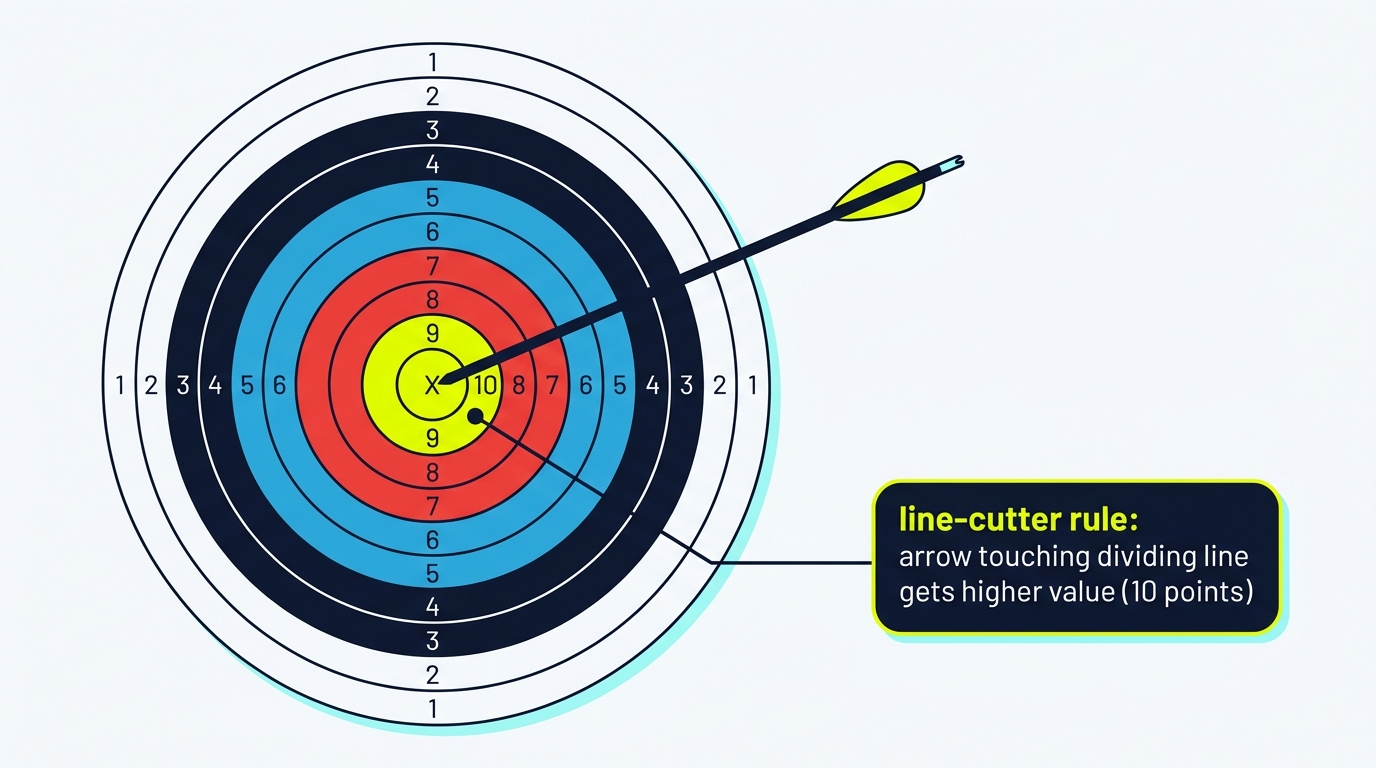
Under official World Archery regulations, standard target faces feature five concentric colored zones, divided into 10 distinct scoring rings numbered from 1 on the outer rim to 10 in the gold center:
- Gold (Yellow Center):
- Inner X-Ring: Worth 10 points. Recorded on your scorecard as an "X" to serve as the ultimate tie-breaker.
- Outer 10-Ring: Worth 10 points.
- 9-Ring: Worth 9 points.
- Red Zone: 8-Ring (8 points) and 7-Ring (7 points).
- Blue Zone: 6-Ring (6 points) and 5-Ring (5 points).
- Black Zone: 4-Ring (4 points) and 3-Ring (3 points).
- White Zone: 2-Ring (2 points) and 1-Ring (1 point).
- Miss (M): Any arrow that lands outside the white border or misses the target butt completely scores 0 points (marked as M on scorecards).
The "Line-Cutter" Rule (Always in the Archer's Favor)
One of the most generous rules in target archery is the Line-Cutter Rule. If your arrow shaft touches even a microscopic fraction of the dark dividing line between two scoring rings, you are automatically awarded the higher point value.
For example, if your arrow lands primarily in the 9-ring but the side of the shaft clearly touches the inner line of the 10-ring, that arrow officially counts as a 10.
2. The Two Major Tournament Scoring Formats
How individual matches are decided depends on the bow division being contested:
1. The Olympic Set System (Recurve and Barebow)
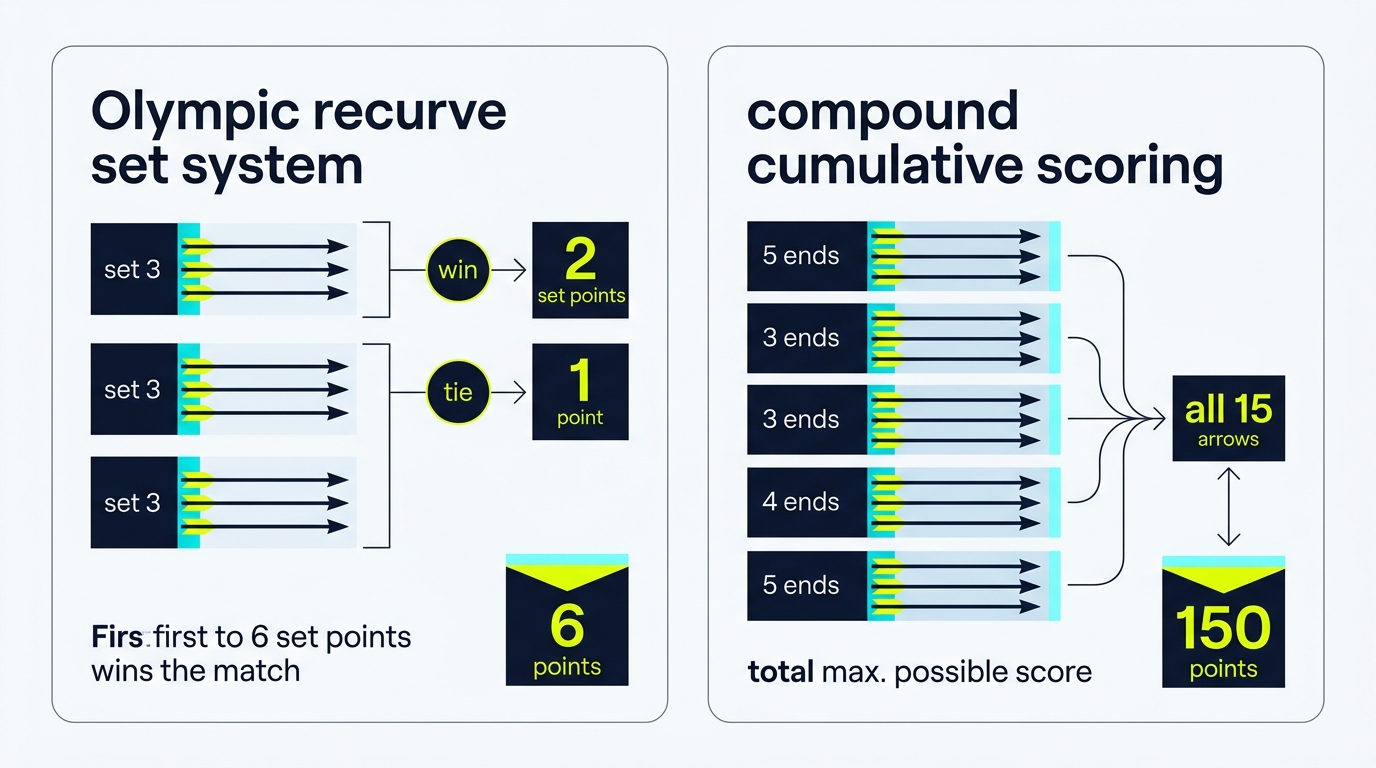
Individual Olympic recurve matches use the Set System (similar to tennis). Instead of adding all arrow scores into one big cumulative total, the match is broken down into mini-games called Sets:
- Each set consists of 3 arrows per archer (maximum possible set score = 30 points).
- Win the Set: The archer with the higher 3-arrow total earns 2 Set Points.
- Tie the Set: If both archers shoot identical totals (e.g., 28–28), each archer receives 1 Set Point.
- Lose the Set: 0 Set Points.
- Victory: The first archer to reach 6 Set Points wins the match!
Why the Set System is great for beginners and viewers: If you shoot one bad arrow (like a 5 in the first set), it only costs you that single set. You can reset mentally, win the next three sets, and still win the match 6–2!
2. Cumulative Scoring (Compound Division)
Because compound archers shoot with extreme mechanical precision and rarely miss the 10-ring, compound matches use Cumulative Scoring:
- Archers shoot 5 ends of 3 arrows (15 total arrows).
- Every single point is added directly to a running total (maximum possible score = 150 points).
- At the end of 15 arrows, whoever has the highest total cumulative score wins the match.
3. The One-Arrow Shoot-Off (Sudden Death)
What happens if a match ends in a deadlock (a 5–5 tie in recurve or a 145–145 tie in compound)? The drama reaches its peak with a One-Arrow Shoot-Off:
- Both archers step up to the shooting line and have 20 seconds to shoot a single arrow.
- If Archer A shoots a 10 and Archer B shoots a 9, Archer A wins immediately.
- If both archers shoot identical scores (e.g., both shoot a 10 or both shoot an 9), a tournament judge measures the physical distance from the center of the X-ring to each arrow shaft with a caliper. The arrow closest to the center X wins the match!
4. Target Face Sizes at a Glance
Depending on the tournament discipline and distance, World Archery uses different target face diameters:
| Discipline & Distance | Target Face Diameter | 10-Ring Size | Scoring System |
|---|---|---|---|
| Indoor Target (18 Meters) | 40 cm (or 3-Spot Vertical) | 4.0 cm (about the size of a golf ball) | Recurve: Set System / Compound: Cumulative |
| Olympic Recurve (70 Meters) | 122 cm Face | 12.2 cm (size of a compact disc) | Set System (First to 6 Set Points) |
| Compound Target (50 Meters) | 80 cm Face (6-ring cut to 5) | 8.0 cm (size of an orange) | Cumulative (5 Ends of 3 Arrows = 150 Max) |
| Traditional Barebow (50 Meters) | 122 cm Face | 12.2 cm | Set System (First to 6 Set Points) |
5. Target Etiquette: Three Rules for Beginners
When walking up to score arrows at a tournament or club event, always observe these standard archery safety protocols:
1. Never Touch the Arrows Before Scoring
Never touch an arrow shaft or the target face until all scores have been officially called and recorded on paper or the electronic tablet. Touching an arrow can push a shaft across a dividing line, causing dispute.
2. Call Scores Highest to Lowest
When calling out your score to the scorekeeper, read your arrows in descending order: for example, "10, 9, 7" (never *"7, 10, 9"*). This makes arithmetic fast and error-free for the registrar.
3. Stand Clear When Arrows Are Being Pulled
When pulling carbon arrows out of high-density target foam, always stand to the side of the target face. Never stand directly behind someone pulling arrows to avoid being hit by the rear nock if an arrow releases suddenly.
Summary: The Joy of Seeing Your Progress in Numbers
Scoring in archery is not about beating everyone around you; it is a personal mirror that measures your focus, form consistency, and mental discipline. Celebrate your 10s, learn from your low arrows, and enjoy every single round on the shooting line!
Curious about how official tournament brackets and eliminations are structured? Check out our guide on How Archery Tournaments Work: What to Expect in Your First Competition.

Dedicated to delivering clear, authoritative, and practical archery education and tournament insight.