Table of Contents
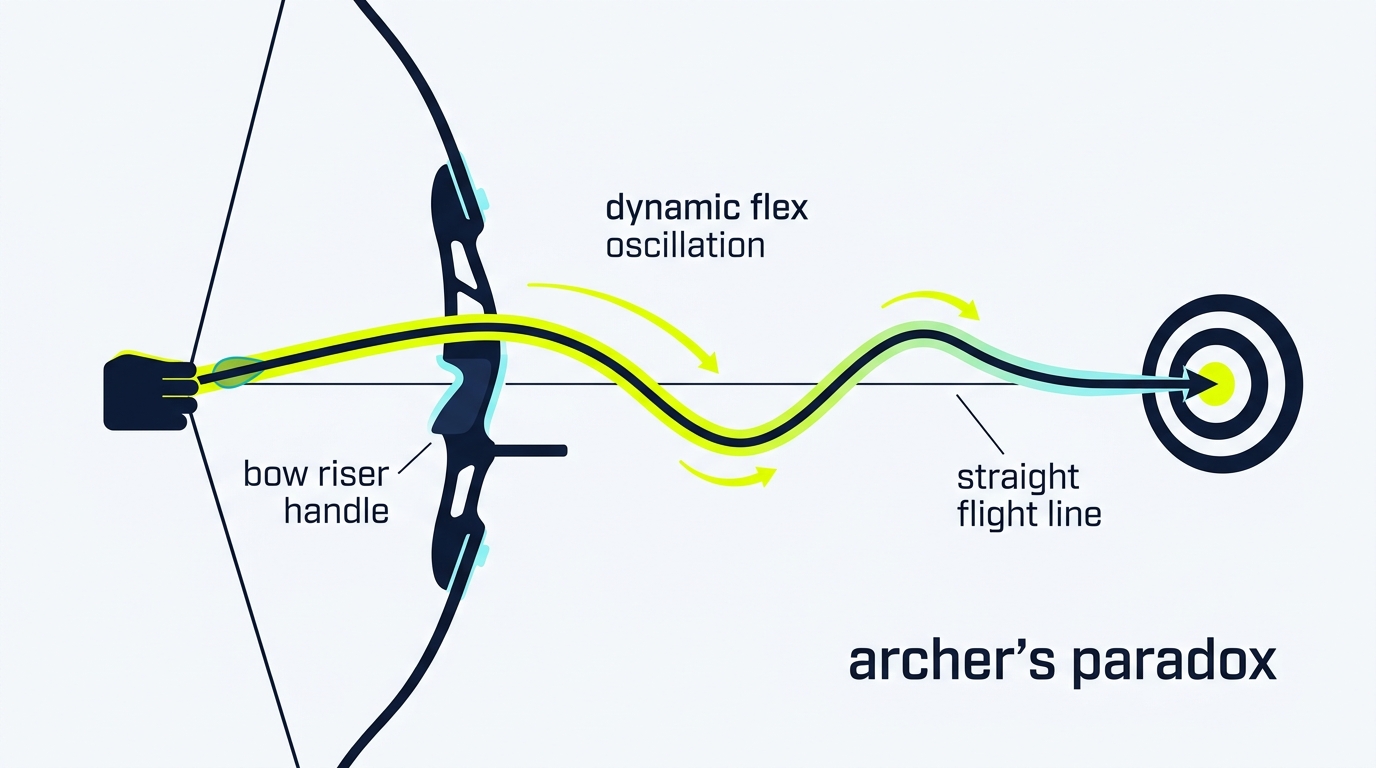
When you watch an archer shoot on television, the arrow appears to dart out of the bow like a laser beam—stiff, straight, and motionless. But if you film that exact same shot with an ultra-high-speed slow-motion camera (running at 5,000 frames per second), you will witness one of the most astonishing optical illusions in all of sports.
The moment the bowstring is released, the heavy carbon arrow does not fly straight. It violently bends into a deep "C" curve, wraps around the bow handle without touching the metal riser, and literally swims through the air like a fish swimming upstream before snapping straight as it strikes the target face.
This mesmerizing physical phenomenon is called the Archer's Paradox, and the scientific property that controls it is called Arrow Spine. If you are new to archery and wondering what mysterious numbers like 500, 700, or 1000 stamped on arrow shafts mean, let's break down the physics into plain, beginner-friendly English.
1. What Is Arrow Spine? (The Stiffness Rating)
In simple everyday terms, Arrow Spine measures the stiffness or flexibility of an arrow shaft. Think of it like comparing a raw piece of spaghetti to a solid steel rod:
- If an arrow is too flexible (like spaghetti), the violent punch of the bowstring will crumple it in mid-air, sending it wobbling out of control.
- If an arrow is too stiff (like a steel rod), it will refuse to bend around the bow handle, violently smacking into the riser and deflecting off target to the left.
To achieve clean, laser-straight flight, an arrow must have the exact right amount of flex to bend around your bow's handle upon release, recover in mid-air, and fly true to the center 10-ring.
2. How the Spine Number Scale Works
When you browse arrow shafts at an archery shop, you will see numbers like 400, 600, 800, or 1200 printed on the carbon tube. Here is the golden rule that confuses almost every beginner:
The Lower the Spine Number, the Stiffer the Arrow. The Higher the Number, the More Flexible the Arrow.
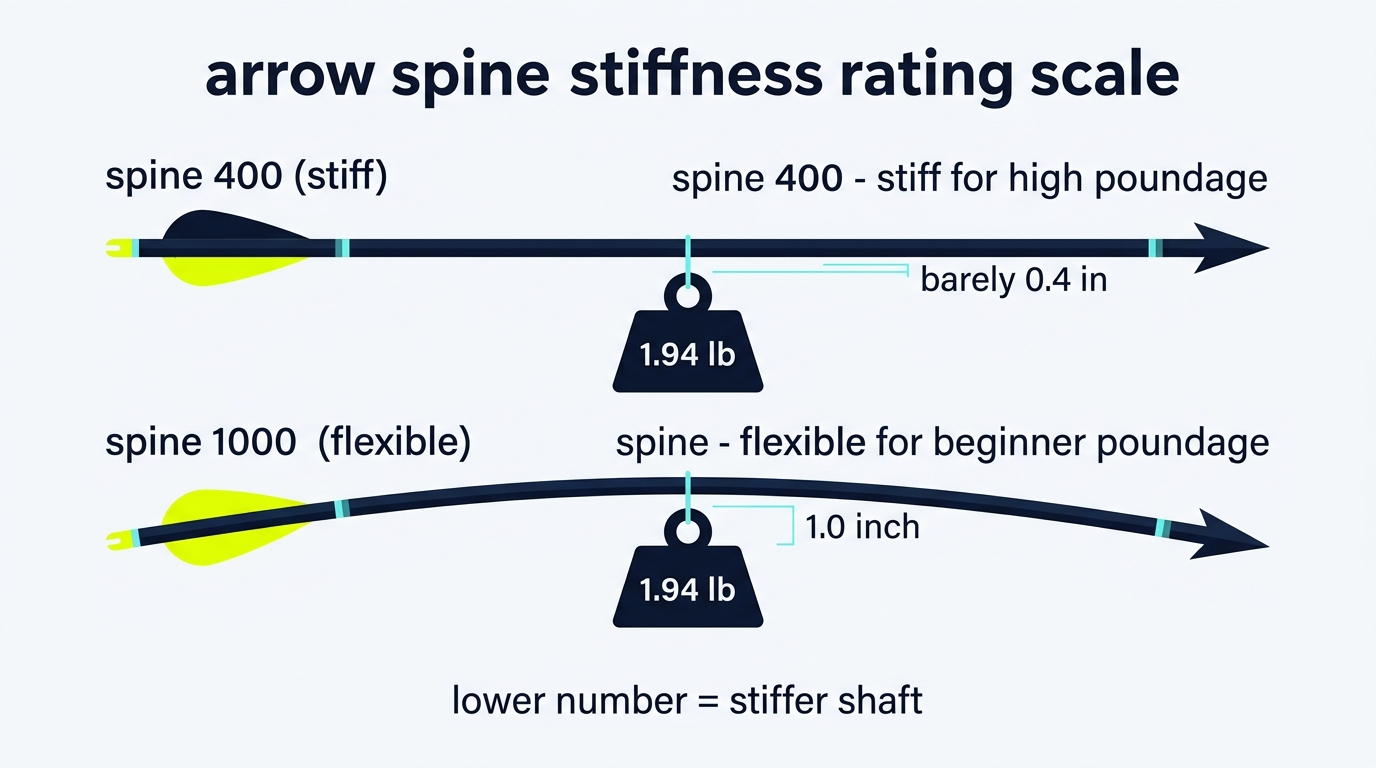
This number comes from an official laboratory measurement called Static Spine. Under the standard ASTM test, a 29-inch arrow shaft is supported on two points spaced exactly 28 inches apart. A heavy 1.94-pound (880-gram) weight is hung directly from the center of the shaft, and engineers measure how many thousandths of an inch the carbon dips:
- A Spine 400 arrow dips only 0.400 inches (very stiff, designed for high-powered 40–50+ lb bows).
- A Spine 1000 arrow dips a full 1.000 inch (very flexible, designed for light 20–24 lb beginner recurve bows).
3. Static Spine vs. Dynamic Spine: What Happens in Flight
While *Static Spine* is measured on a static workshop table, Dynamic Spine is how the arrow actually bends in real life when launched from your bow.
Several real-world factors alter your arrow's dynamic flex during a shot:
1. Point Weight (The Tip)
Gluing a heavier steel point (e.g., jumping from a 70-grain point to a 120-grain point) onto the front of your arrow adds forward inertia. When the bowstring pushes the rear nock forward, the heavy front tip resists moving immediately, forcing the carbon shaft to bend significantly deeper. Heavier point = Weaker dynamic spine.
2. Shaft Length
A longer arrow flexes much easier than a short arrow, just like a long wooden plank bends more under your feet than a short board. Cutting 1 inch off your arrow shaft makes it noticeably stiffer in flight. Shorter shaft = Stiffer dynamic spine.
3. Bow Draw Weight
A 40-pound bow punches the back of the arrow with twice as much kinetic force as a 20-pound bow, requiring a much stiffer shaft (e.g. Spine 500) to avoid dangerous buckling.
4. Quick-Glance Spine Selection Chart for Beginners
To help you choose the correct starting arrows for your setup, use this general guideline table for target recurve archers:
| Actual Holding Poundage | Draw Length 26" – 27" | Draw Length 28" – 29" | Draw Length 30" – 31" |
|---|---|---|---|
| 16 – 20 lbs (Youth / Light) | Spine 1300 – 1400 | Spine 1100 – 1200 | Spine 1000 – 1100 |
| 20 – 24 lbs (Adult Beginner) | Spine 1100 – 1200 | Spine 900 – 1000 | Spine 800 – 900 |
| 26 – 30 lbs (Intermediate) | Spine 900 – 1000 | Spine 700 – 800 | Spine 600 – 700 |
| 32 – 38 lbs (Advanced) | Spine 700 – 800 | Spine 600 – 650 | Spine 500 – 550 |
| 40+ lbs (Competitive) | Spine 550 – 600 | Spine 450 – 500 | Spine 380 – 420 |
5. Three Practical Arrow Tips for Beginners
1. Never Buy Arrows Based on Your Gym Strength
The most common beginner mistake is ordering stiff 400-spine carbon arrows online because they look cool. On a 22-lb beginner recurve bow, a 400-spine arrow will fly like a rigid metal pole, violently slapping against your arrow rest and kicking far to the left.
2. Leave 1 Inch of Extra Length Beyond the Arrow Rest
When ordering your first set of arrows, have the pro shop cut them so the shaft extends approximately 1 to 1.5 inches past your arrow rest at full draw. This extra safety buffer ensures the razor point will never accidentally slip behind the bow handle during aiming.
3. Check Manufacturer Spine Charts Before Buying
Different arrow manufacturers (like Easton, Skylon, Gold Tip, or Black Eagle) have slight variations in carbon weave. Always check the official manufacturer spine matrix table using your measured draw length and actual limb poundage before purchasing a dozen shafts.
Summary: Matching Arrow Flex to Bow Power
Arrow spine is not an obscure math puzzle—it is the hidden rhythm that allows your arrow to dance cleanly around your bow and find the yellow center. When your arrow spine matches your draw weight, every shot feels smooth, quiet, and effortless.
Now that your equipment and arrows are dialed in, learn how every shot is scored in our complete guide on How Archery Scoring Works: Points, Rings, and Match Rules Made Simple.

Dedicated to delivering clear, authoritative, and practical archery education and tournament insight.