Table of Contents
One of the most exciting aspects of archery is how the sport completely transforms twice every year. From October through March, archers step indoors into climate-controlled sports halls, shooting at close-range targets under bright stadium lights. Then, as spring arrives in April, the entire community moves outdoors onto vast, sun-drenched grass fields, battling shifting crosswinds and summer heat.
While your core shooting form remains identical across both seasons, the equipment setups, mental strategies, and physical challenges could not be more different. If you are preparing for your first indoor winter league or transitioning to outdoor distances, here is your beginner-friendly guide to understanding the real differences between indoor and outdoor archery.
1. Distance and Target Scaling: 18 Meters vs. 50/70 Meters
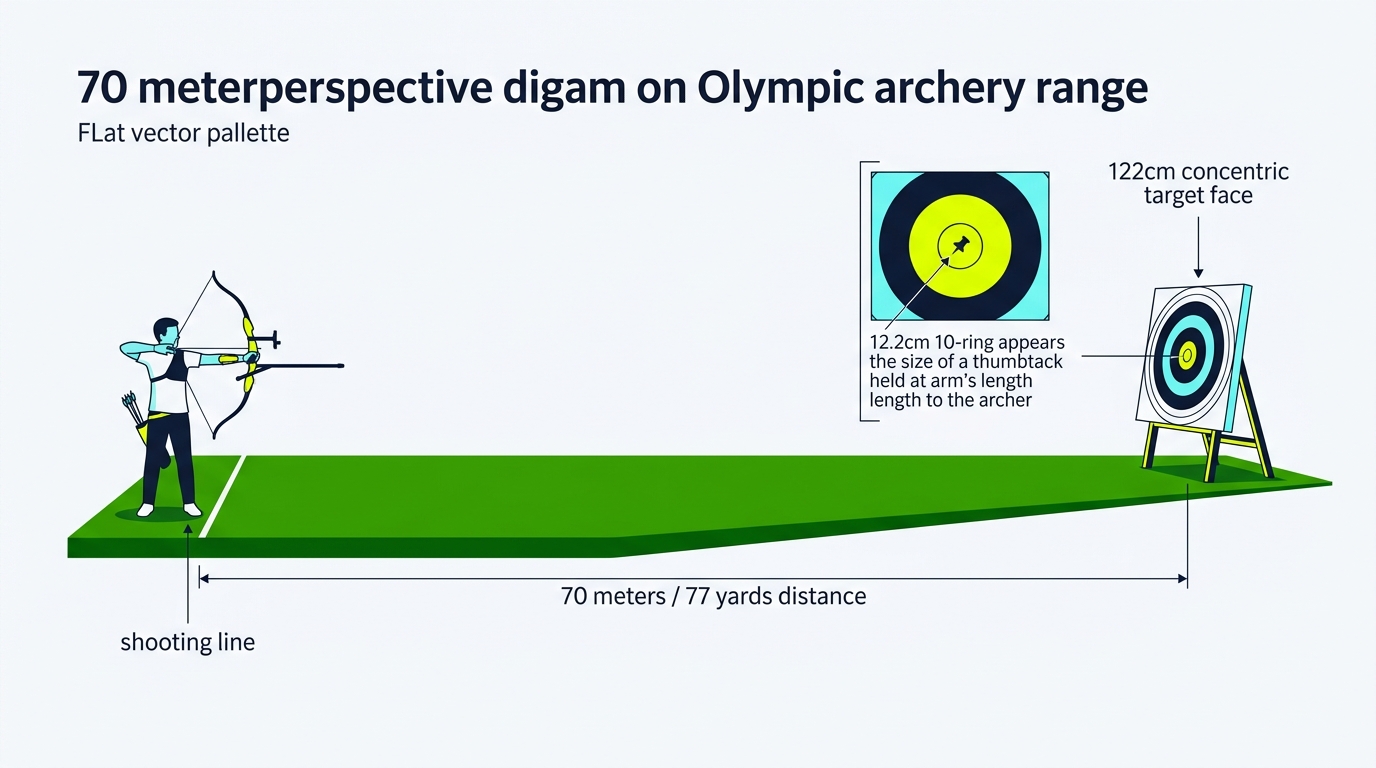
The most immediate difference between indoor and outdoor archery is the shooting distance:
- Indoor Season: Shot at a standardized distance of 18 meters (20 yards) using a 40-centimeter target face. At 18 meters, the yellow 10-ring is exactly 4.0 cm wide (roughly the size of a golf ball).
- Outdoor Season:
- Olympic Recurve & Barebow: Contested at 70 meters (Recurve) and 50 meters (Barebow) using a massive 122-centimeter target face.
- Compound Division: Contested at 50 meters using an 80-centimeter target face (where the outer scoring rings 1 through 5 are removed).
The Mental Shift: Indoor archery is an intense psychological microscope on form perfection—because 18 meters is close, every slight mistake shows up immediately on the target. Outdoor archery, by contrast, is an epic battle of ballistics, trajectory, and reading natural weather elements.
2. The Triple-Spot Target: Why Indoor Archers Shoot Columns
Walk onto an indoor tournament range, and you will notice that most experienced archers do not shoot at a single 40cm circle. Instead, their target paper features three smaller targets stacked vertically in a column, known as a Triple-Spot (or 3-Spot) Face.
Why do archers shoot one arrow into each of the three separate circles?
To prevent the expensive "Robin Hood Problem"! Because modern archers shoot with extreme precision at 18 meters, shooting three carbon arrows into a single 4.0 cm bullseye means the second and third arrows will violently telescope into the back of the first arrow, splintering expensive shafts and destroying nocks. Shooting one arrow per spot guarantees each shaft has its own private landing zone.
3. Arrow Sizing: Fat Indoor Logs vs. Skinny Outdoor Needles
Did you know that archers use completely different arrows depending on whether they are shooting indoors or outdoors? Here is the clever science behind arrow diameter:
Indoor Arrows: The "Line Cutters"
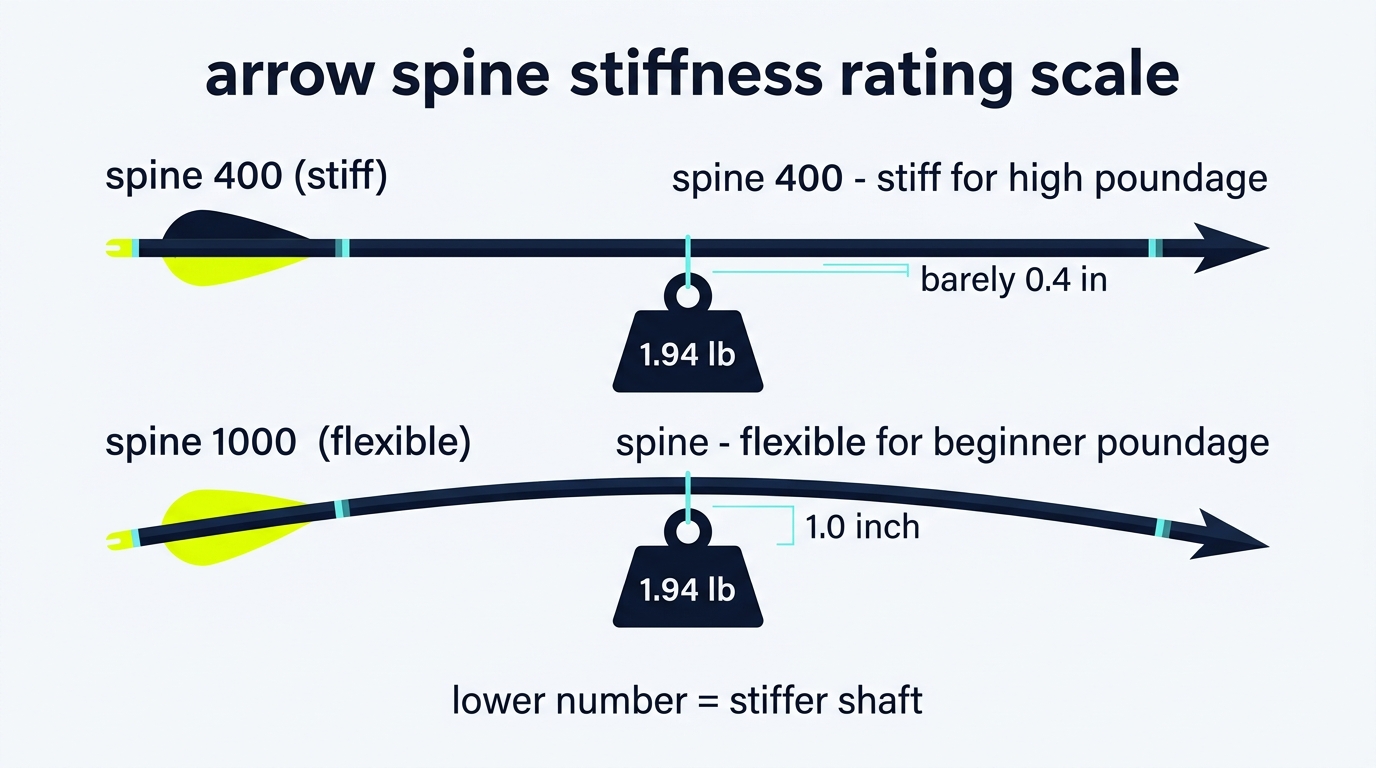
Indoors, there is zero wind. Therefore, archers want the thickest arrow allowed by World Archery rules (up to 9.3 millimeters or 23/64" diameter—often called "23-diameter logs"). Because a fat arrow takes up more physical space on the paper, its outer edge is far more likely to touch a dividing line and score a higher point value under the line-cutter rule.
Outdoor Arrows: The "Wind Needles"
Outdoors, a fat arrow would act like a sail, catching every gust of crosswind and blowing far off target at 70 meters. Outdoor archers use ultra-skinny micro-diameter carbon shafts (4.0 mm diameter). These needle-thin shafts minimize surface drag, slicing cleanly through gusts of wind with minimal drift.
4. Environmental Variables: The Battle with Nature
Shooting outdoors introduces natural elements that test an archer's adaptability:
- Crosswinds: A 12 mph crosswind can push a 70-meter recurve arrow over 12 inches to the side. Elite archers learn to read wind flags and deliberately aim into the red or blue rings (*"aiming off"*) so the wind blows the arrow back into the yellow 10-ring.
- Sunlight and Shadows: Direct overhead sunlight illuminates your sight pin differently than an overcast cloud cover. Bright sunlight makes the sight pin glow brightly, which can trick your eye into aiming slightly low.
- Rain and Moisture: Raindrops on your bowstring add weight, slightly reducing arrow speed. Outdoor archers carry dry microfiber towels to keep their finger tabs and grips completely dry between ends.
5. Direct Comparison: Indoor vs. Outdoor Archery at a Glance
The table below summarizes the key differences between the two competitive seasons:
| Feature / Parameter | Indoor Archery | Outdoor Archery |
|---|---|---|
| Competition Season | Autumn & Winter (October – March) | Spring & Summer (April – September) |
| Standard Distance | 18 Meters (20 Yards) | 50m (Compound/Barebow) & 70m (Recurve) |
| Target Face Options | 40 cm Single Face or Vertical 3-Spot | 122 cm Face (Recurve) / 80 cm Face (Compound) |
| Arrows per End | 3 Arrows per End (20 Ends = 600 Max) | 6 Arrows per End (12 Ends = 720 Max) |
| Arrow Diameter Preference | Thick 9.3mm "Line Cutter" Shafts | Ultra-skinny 4mm Micro-Diameter Shafts |
| Environmental Factors | Zero wind; climate-controlled; artificial light | Wind gusts, direct sunlight, rain, humidity |
| Primary Training Focus | Flawless release timing & mental focus | Wind compensation, stamina & long-range elevation |
6. Three Tips for Transitioning Between Seasons
When moving from indoor shooting to outdoor fields (or vice versa), keep these practical tips in mind:
- Never Move Directly from 18m to 70m: If you have spent all winter shooting at 18 meters, your muscle memory is dialed for a flat trajectory. Step back gradually: shoot at 30m first, then 50m, before moving all the way to 70m.
- Record Your Sight Marks in a Notebook: Write down your exact sight elevation numbers for 18m, 30m, 50m, and 70m in your phone or archery notebook so you never waste tournament practice ends guessing your height.
- Embrace the Weather: Do not avoid practicing when it is windy or drizzling outside. The archer who learns to shoot with confidence in the wind will always have a massive advantage on tournament day!
Summary: Two Seasons, One Incredible Sport
Indoor archery gives you the calm sanctuary to refine your muscle memory, while outdoor archery offers the exhilarating thrill of sending arrows soaring across open fields under the sun. Embrace both seasons, enjoy the variety, and keep shooting with confidence!
Curious about archery beyond flat fields? Discover field and 3D archery in our guide on Target, Field, or 3D Archery: Which Shooting Style Is Right for You?.

Dedicated to delivering clear, authoritative, and practical archery education and tournament insight.